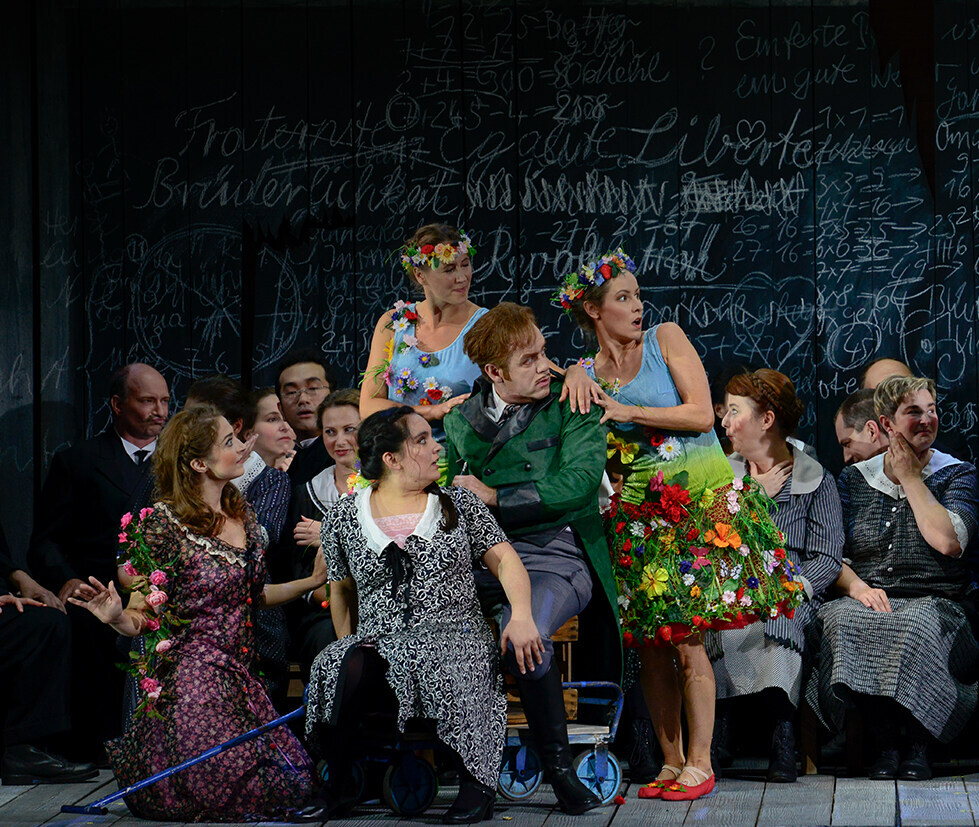
An entertaining battle of the sexes full of charm, wit and joie de vivre.
Operetta in three acts
Libretto by Victor Léon and Leo Stein based on the comedy L’attaché d’ambassade by Henri Meilhac
Performed in German with German and English surtitles
Premiere
29. November 2026
Dates & Cast
- Conductor Killian Farrell (29. November, 02., 12., 27. December 2026, 08., 10., 15., 17., 25., 31. January 2027), Marcus Merkel (01. January 2027)
- Staging Dirk Schmeding
- Set Design Martina Segna
- Costume Design Frank Lichtenberg
- Lighting Design Fabio Antoci
- Choreography Kerstin Ried
- Choir Jan Hoffmann
- Dramaturgy Dorothee Harpain
- Baron Mirko Zeta Markus Marquardt
- Valencienne Magdalena Lucjan
- Graf Danilo Danilowitsch Johannes Martin Kränzle
- Hanna Glawari Erica Eloff
- Camille de Rosillon Mario Lerchenberger
- Vicomte Cascada Jürgen Müller
- Bogdanowitsch Martin-Jan Nijhof
- Njegus Sabine Brohm
- Graf Danilo Johannes Martin Kränzle
- Conductor Killian Farrell
- Staging Dirk Schmeding
- Set Design Martina Segna
- Costume Design Frank Lichtenberg
- Lighting Design Fabio Antoci
- Choreography Kerstin Ried
- Choir Jan Hoffmann
- Dramaturgy Dorothee Harpain
- Baron Mirko Zeta Markus Marquardt
- Valencienne Magdalena Lucjan
- Graf Danilo Danilowitsch Johannes Martin Kränzle
- Hanna Glawari Erica Eloff
- Camille de Rosillon Mario Lerchenberger
- Vicomte Cascada Jürgen Müller
- Bogdanowitsch Martin-Jan Nijhof
- Njegus Sabine Brohm
- Graf Danilo Johannes Martin Kränzle
- Conductor Killian Farrell
- Staging Dirk Schmeding
- Set Design Martina Segna
- Costume Design Frank Lichtenberg
- Lighting Design Fabio Antoci
- Choreography Kerstin Ried
- Choir Jan Hoffmann
- Dramaturgy Dorothee Harpain
- Baron Mirko Zeta Markus Marquardt
- Valencienne Magdalena Lucjan
- Graf Danilo Danilowitsch Johannes Martin Kränzle
- Hanna Glawari Erica Eloff
- Camille de Rosillon Mario Lerchenberger
- Vicomte Cascada Jürgen Müller
- Bogdanowitsch Martin-Jan Nijhof
- Njegus Sabine Brohm
- Graf Danilo Johannes Martin Kränzle
- Conductor Killian Farrell
- Staging Dirk Schmeding
- Set Design Martina Segna
- Costume Design Frank Lichtenberg
- Lighting Design Fabio Antoci
- Choreography Kerstin Ried
- Choir Jan Hoffmann
- Dramaturgy Dorothee Harpain
- Baron Mirko Zeta Markus Marquardt
- Valencienne Magdalena Lucjan
- Graf Danilo Danilowitsch Johannes Martin Kränzle
- Hanna Glawari Erica Eloff
- Camille de Rosillon Mario Lerchenberger
- Vicomte Cascada Jürgen Müller
- Bogdanowitsch Martin-Jan Nijhof
- Njegus Sabine Brohm
- Graf Danilo Johannes Martin Kränzle
- Conductor Killian Farrell
- Staging Dirk Schmeding
- Set Design Martina Segna
- Costume Design Frank Lichtenberg
- Lighting Design Fabio Antoci
- Choreography Kerstin Ried
- Choir Jan Hoffmann
- Dramaturgy Dorothee Harpain
- Baron Mirko Zeta Markus Marquardt
- Valencienne Magdalena Lucjan
- Graf Danilo Danilowitsch Johannes Martin Kränzle
- Hanna Glawari Erica Eloff
- Camille de Rosillon Mario Lerchenberger
- Vicomte Cascada Jürgen Müller
- Bogdanowitsch Martin-Jan Nijhof
- Njegus Sabine Brohm
- Graf Danilo Johannes Martin Kränzle
- Conductor Marcus Merkel
- Staging Dirk Schmeding
- Set Design Martina Segna
- Costume Design Frank Lichtenberg
- Lighting Design Fabio Antoci
- Choreography Kerstin Ried
- Choir Jan Hoffmann
- Dramaturgy Dorothee Harpain
- Baron Mirko Zeta Markus Marquardt
- Valencienne Magdalena Lucjan
- Graf Danilo Danilowitsch Johannes Martin Kränzle
- Hanna Glawari Erica Eloff
- Camille de Rosillon Mario Lerchenberger
- Vicomte Cascada Jürgen Müller
- Bogdanowitsch Martin-Jan Nijhof
- Njegus Sabine Brohm
- Graf Danilo Johannes Martin Kränzle
- Conductor Killian Farrell
- Staging Dirk Schmeding
- Set Design Martina Segna
- Costume Design Frank Lichtenberg
- Lighting Design Fabio Antoci
- Choreography Kerstin Ried
- Choir Jan Hoffmann
- Dramaturgy Dorothee Harpain
- Baron Mirko Zeta Markus Marquardt
- Valencienne Magdalena Lucjan
- Graf Danilo Danilowitsch Johannes Martin Kränzle
- Hanna Glawari Erica Eloff
- Camille de Rosillon Mario Lerchenberger
- Vicomte Cascada Jürgen Müller
- Bogdanowitsch Martin-Jan Nijhof
- Njegus Sabine Brohm
- Graf Danilo Johannes Martin Kränzle
Related event
In brief
What can be done to save the impending bankruptcy of the principality of Pontevedro? Fortunately, Baron Zeta has a brilliant plan: Count Danilo, his work-shy but erotically restless secretary, must marry the wealthy widow Hanna Glawari, who has just arrived in Paris. However, Danilo faces stiff competition, and, when he recognises the millionaire widow to be his former flame, he vows never to confess his love to her …
Franz Lehár (1870–1948) captured the spirit of his age with Die lustige Witwe, which premiered in Vienna in 1905. To this day, it remains one of the most beloved and frequently performed operettas. Drawing on a comic play by Henri Meilhac, the libretto by Victor Léon and Leo Stein presents an entertaining battle of the sexes in a tale that shifts between irony and melancholy, lightness and emotional depth.
Lehár’s score combines rousing dances from the polka to the cakewalk with unforgettable earworms such as the “Vilja Song”, “Da geh’ ich ins Maxim” and “Lippen schweigen”. Brimming with charm, wit and vitality, Die lustige Witwe paints an ageless portrait of our earthly desires.